Showing posts with label east 86th street. Show all posts

Saturday, November 24, 2018

Park Avenue Methodist Church - 106 East 86th Street


In 1768 property, 42 feet wide by 60 feet deep,was acquired on John Street, near Nassau by the first Methodist congregation in America.  The John Street Church, popularly known as Wesley's Chapel, was opened in October that year.  From that humble start, Methodism spread.  

In the spring of 1837 a new congregation was formed well north of the city in the village of Yorkville.  In a coincidence of timing, the venerable John Street Church was being demolished at the time.   On February 1, 1837 that year The Herald had reported "The property on which the Methodist Church in John street stood is said to be forfeited by the late sale and conversion of it into stores."

Under the leadership of Rev. Daniel De Vinne the Methodist Episcopal Church in Yorkville purchased four plots on what would become East 86th Street, and according to The New York Times decades later (on November 12, 1882), the old structure "was purchased by the Eighty-sixth-Street congregation and removed to the site of their present house in 1837."

The Yorkville congregation outgrew the building within two decades.  "In this venerable old edifice worship was conducted until 1858, when it was torn down and a new brick church was erected in its place at a cost of $9,800," reported The Times.  But it was not entirely the end of the historic structure.  The article went on to say "At the erection of the second church building a single beam of the old John-street wood was placed under the kneeling-board in front of the altar."

By 1882 Yorkville was no longer a distant hamlet; but a part of the steadily growing city.  The congregation had once again outgrown its building.  In August ground was broken for a new church directly across 86th Street and on November 12 The New York Times reported that the laying of the cornerstone would take place the following day.  The article noted that the wood from the John Street Church "will be removed and placed in a similar position in the new...church so that the church will retain its claim to material, as well as spiritual descent from the first of American Methodist churches."

With the new building came a new name.  On April 2, 1883 The New York Times announced "This organization will soon be known as the Park-Avenue Church, as it is now building a fine house of worship at Park-avenue and Eighty-sixth-street."  

That impressive structure was designed by well-known architect J. Cleveland Cady.  The eccentric design in included a 150-foot tall corner tower, "built after the style of the Campanile in Florence" and gargoyles on the Park Avenue elevation "which have the face of a tiger, the wings of a bat and the claws of an eagle."  The cost, including the land, would equal $5.68 million today.

At the time the Park-Avenue Methodist Episcopal Church had a membership of more than 700, described by The New York Times as "fashionable."  Nevertheless, it would be another 21 years before the $40,000 mortgage would be paid off.  On March 18, 1905 the New-York Tribune reported that the debt was finally paid off.  The celebratory service, predicted the newspaper "will be a memorable one in the long history of the Old Eighty-sixth Street Church, as it has always been known."

Debt would come again in the 1920's.  A new concept was sweeping metropolitan areas--the "skyscraper church."   Congregations from coast to coast were demolishing their old structures and building apartment or office buildings which incorporated a ground floor church space.  In theory the congregation would reap tremendous income from the rental properties.  Not everyone was thrilled by the concept.  The New York Times, for instance, editorialized, "Must we visualize a New York in which no spire points heavenward?"

By now the Park Avenue corner sat within a much-changed neighborhood.  Old houses and shops had been pulled down to be replaced by jazz-age apartment buildings.  The property on which the church stood was ripe for similar development.

On July 6, 1924 The New York Times wrote "The decision of the Park Avenue Methodist Church to tear down its present edifice for the erection on the site of a fifteen-story apartment house, the lower four floors of which will be utilized for the continuance of the church activities, there is presented not only another striking illustration of the changing conditions for successful church management in certain parts of the city, but also additional evidence of the increasing popularity of East Eighty-sixth Street as an apartment residential thoroughfare."

As the trustees worked with architect Henry C. Pelton, the concept changed.  A year later, on July 27, 1925, they announced that the 15-story apartment building plan would go ahead; but without the church.  A separate, three-story structure would be erected for that purpose directly behind, on 86th Street.

The trustees estimated the rental income from the apartments at "not less than $10,000 a year," according to The Times.  "The church believes that this sum will almost pay the running expenses of the congregation."  Cady's brownstone structure was razed in July 1925 and construction was immediately begun on the new buildings.

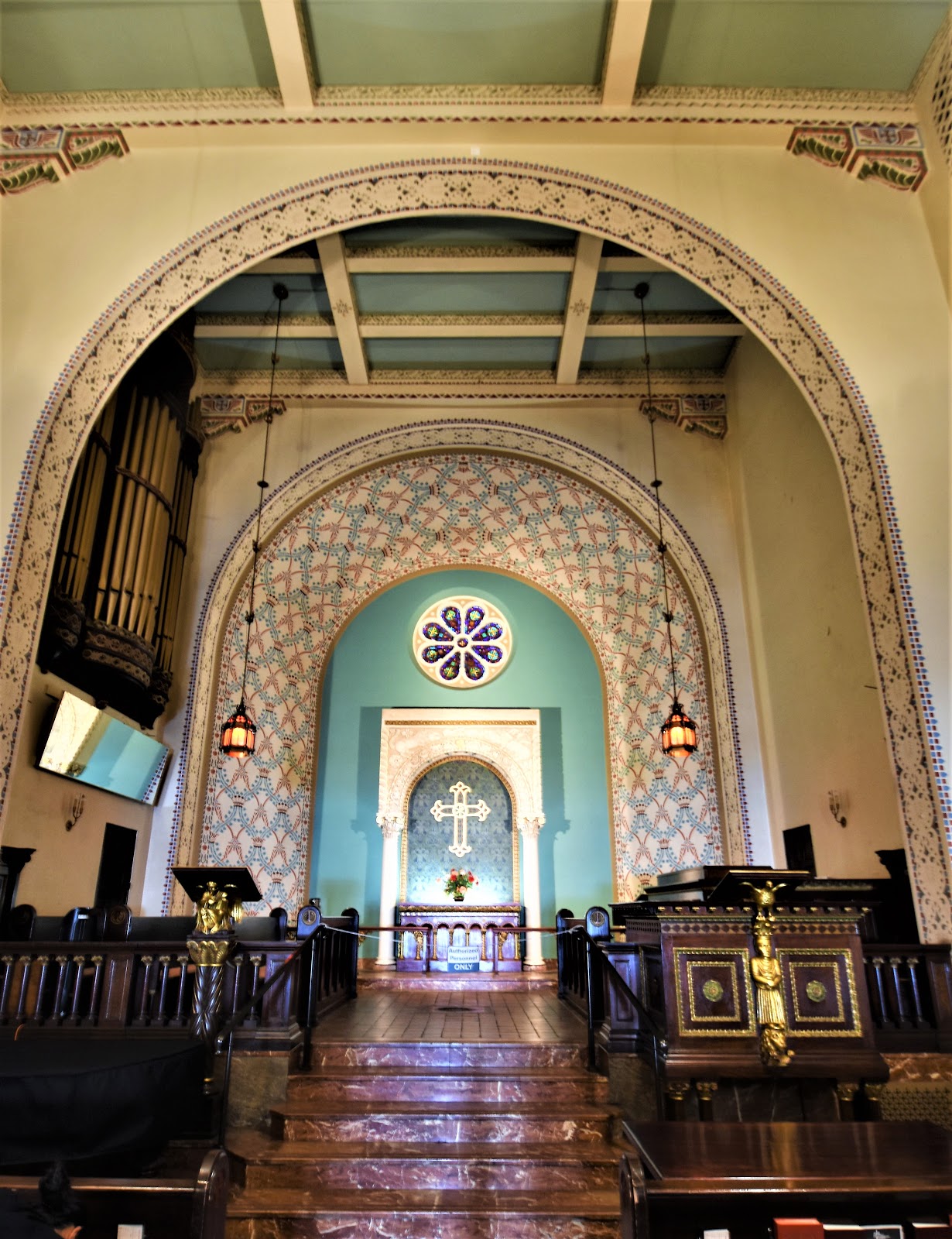
The cornerstone of the church was laid on March 23, 1926.  The Times noted that it "will be in the Byzantine style.  It will contain an auditorium, to seat 537 people, on the street level, with Sunday School, social rooms and a pastor's study on the two upper floors."  "Byzantine" was a  broad description, and Henry C. Pelton's design drew heavily from the Southern Sicilian Romanesque style.

Three months after the dedication, Samuel H. Gottscho photographed the new building.  from the collection of the Museum of the City of New York
The $250,000 structure was dedicated by Bishop Luther B. Wilson on January 8, 1927.  A separate dedication service was held later that evening for the new Skinner organ.

For decades the annual New York Methodist Conference had taken place in the Park-Avenue Methodist Church, and they continued within the new building.  At the time of its dedication Prohibition was a flashpoint of controversy as hundreds of thousands of citizens sought its repeal.  The Methodist Church was firmly in favor of Prohibition, as evidenced in the Conference meetings here on April 3, 1927.

Dr. Clarence True Wilson, general secretary of the Board of Temperance, Prohibition and Public Morals of the Methodist Church asserted "The liquor traffic is in the course of ultimate extinction."  He insisted that the newspaper accounts were fake news.  "There are those who would have you believe there is a great uprising against prohibition, but this is not so."

Pelton carried on the Southern Sicilian Romanesque motif inside with the tile-paved floor and simple stenciled walls.
Four years later his stance was embraced by the Rev. Dr. James Josiah Henry, new pastor of the Park Avenue Methodist Church.  In his sermon on October 25, 1931 he claimed that the New York newspapers were not giving a "true picture" of Prohibition; saying in part "It is this unfairness that has led so many people to state that the eighteenth amendment and the Volstead act cannot be enforced.  This is utterly false."

In the meantime, the sometimes bland meetings of the New York Methodist Conference were enlivened by an arrest in April 1930.  Two years earlier Rev. L. B. Haines conducted the wedding ceremony of John Willis and Ella Acker.   Rev. Haines later learned that the 74-year old bridegroom was already married.  Six weeks after the sham marriage Willis deserted Ella and returned to his first wife, who was none the wiser.

John Willis was described by The New York Times as being "fond of religious services."  And so he attended a session of the Conference in the Park Avenue Methodist Church.  The last person he expected to be there was the Rev. L. B. Haines.   Haines slipped out of the church and found a policeman.

On April 8 The New York Times reported "With his two wives in court sympathizing with each other and united in indignation against him, John Willis, 76 years old, pleaded guilty to bigamy yesterday."

The "society room" with its plaster walls and tiled hearth had a monastic feeling. photo by Samuel H. Gottscho, March 25, 1927, from the collection of the Museum of the City of New York
From the pulpit Rev. John J. Henry did not hold back in his often spirited social and political opinions.  Ardently anti-union, he announced in his July 22, 1934 sermon that "Reds and radicals" were responsible for the recent strikes on the West Coast.  He told the story of a manufacturer who, when he found his plant was being picketed, invited the employees to go fishing with him.  The next morning everything was fine within the factory.

"But you cannot treat radicals and Reds that way...They are simply suffering from industrial insanity and they are seeking to destroy our industrial system."  He then turned to commercial isolation, the Depression Era version of America First.  "We could not possibly supply the rubber needed by our great automotive industry.  So it is well to remember when we grow too cocky that we could not get along without Brazil.  If we close the door to Cuban sugar in order to aid our own sugar interests, we only punish ourselves.  If a man makes a corner in wheat on the Chicago market, peasants on the slopes of the Alps may starve."

He broadened that stance in September 13, 1936 by including the welcoming of all peoples.  The Times wrote "Nationalism and high racial feeling he described as evils which tend to destroy representative government."

In his sermon he said in part "I hope there will come a time in the future when you can love the man who lives in the Ukraine, Germany, Holland and other countries just as well as you love your own race and nation.  I say this because I believe there is an Almighty God.  Unfortunately, the world is not yet in that condition of mind.  Too many still believe that 'blood is thicker than water.'"

Seven months after that sermon the Park Avenue Methodist Church was in trouble.  The income from the apartment building, which the trustees had assumed would carry expenses, fell short.  On April 26, 1937 The Times ran the headline "Park Ave. Methodist Faces Loss of Home."  The original 10-year $800,000 mortgage on both properties--a considerable $13.7 million today--was now due.  The article explained that Rev. Henry had asked members to "confer Friday evening on steps to prevent the threatened loss of the church of its place of worship."

As the financial crisis dragged on Rev. Henry returned his focus on social and political issues.  Naturally, war, Nazism and Facism would soon be on the top of his list.  Nearly three months before America was pulled into the conflict with the attack on Pearl Harbor he railed against Hitler and warned of repeating the mistakes of World War I.

In his September 14, 1941 sermon he cautioned against the "mistake of the 1918 Armistice."  He said that just as the Allied armies were ready to enter Germany "and crush a power that was menacing the world," the Armistice stopped them.  Now, he stressed, "as defenders of religion it is our duty to destroy sin and hate--everything that Hitler represents."

Rev. Henry stepped down because of poor health around 1945, ending a colorful chapter in the history of the Park Avenue Methodist Church.  His retirement came at a time when the church's financial condition had once again become a crisis.  The Methodist Church ordered the congregation to close in 1946; but appeals by members to the United Methodist Society resulted in financial support and a 10-year reprieve.  In 1956 the apartment building was sold.


Financially secure today, the church continues to serve the the neighborhood--one drastically different from the rural hamlet where it was founded nearly 190 years ago.

photographs by the author

Friday, September 28, 2018

S. Edson Gage's Corn Exchange Bank - 124-126 East 86th Street


Founded in 1853, the Corn Exchange Bank had grown prodigiously by the turn of the century.  Branches sprouted throughout the city as the population shifted; and in the spring of 1914 another was on the horizon.

On April 17 The New York Times reported "The Corn Exchange Bank has purchased from Bella Glaser the two old five-story flats at 124 and 126 East Eighty-sixth Street...While the bank officers have not fully determined upon the changes to the property, it has been decided to alter the lower floor of the house at 126 and establish a branch of the Corn Exchange Bank there in the near future."  The article noted that later "the entire property may be improved with a large banking office on the ground floor."

The trustees soon made up their minds.  Within two months they had remodeled the ground floor of No. 124 as a banking office and on June 21, 1914 The Times reported "The adjoining structure at 126 has been torn down, and work is now under way for an artistic two-story building, which will be exclusively used by the bank when completed in the Fall."

The Corn Exchange Bank routinely used the talents of architect S. Edson Gage for its structures.  His neo-Classical designs were tried and true, and his branch bank buildings were often slight variations of one another.  Such would be the case with No. 126.  Its clean neo-Classical facade featured a double-height arch and shallow understated pilasters.

The two-story bank building stood out on the brick and brownstone lined block.  photo by Wurtz Bros. from the collection of the Museum of the City of New York
The 86th Street Corn Exchange Bank became part of an economic-political scandal in 1922 involving the mayor, Tammany Hall big shots and a shady character called Fishhooks McCarthy.   The Transit Commission had launched an investigation into the operation of bus lines, the operating permits of which were granted by the mayor's office.

A powerful figure within the Tammany organization was John A. McCarthy.  On October 26, 1922 the New-York Tribune reminded its readers "McCarthy is the same 'Fishhooks' McCarthy who recently pleaded guilty of conspiracy in restraint of trade with other members of the builders' ring."

The new bus lines, which included the crosstown Eighty-sixth Street line, had been advocated by Mayor John Hylan, and now it appeared that his office was giving control of the lucrative lines to Tammany affiliates.

In the course of testimony on October 25 it was revealed that "Fishhooks" McCarthy was "the virtual owner of the profitable Eighty-sixth Street bus line."  Although his name did not appear on the paperwork, he had provided the money for the permit to "dummies."  They would then deposit the receipts into McCarthy's account in the Corn Exchange Bank on 86th Street.  The buses took in about $40 per day--more than $4,000 a week today.

Clarence J. Shearn told reporters he expected "in the light of yesterday's revelations, to be able to show a clear and far more extensive connection between the newly established bus lines of the city and Tammany Hall, the bus lines lining the pockets and enhancing the political prestige of the district leaders."

Earlier that year two boys, 14-year-old Charles Wolfe and 15-year-old Oscar Spiegel were passing the bank when they noticed a slip of paper on the sidewalk.  (The New York Herald mentioned that "Oscar is a water boy in a theater and Wolfe is a high school student.")   The paper was a check for $50 payable to Sarah Wendell, who had apparently dropped it on her way into the bank.

The teens weighed their options--turning in the check worth about $731 in today's money, or cashing it.  They chose the latter.  They carefully signed Sarah Wendell's name to the back of the check, then cashed it at the Emanuel Hayman's stationery store on Third Avenue.  While Hayman's trust seems on the surface naive (or even stupid), he knew the grandmother of one of the boys.

While there Oscar and Charles purchased a $15 electric train.  They walked out with the $35 change which they divided and then went to the movies "and otherwise enjoyed themselves until it was gone," according to detectives.  Their enjoyment was short lived.

When Hayman went to the bank and found the check was "wrongly endorsed" he notified the police, who were given the address of the grandmother.   The boys were arrested within hours.

Eleven years after he had designed the 86th Street building S. Edson Gage was brought back to enlarge it.  The old building at No. 124 was demolished and Gage doubled the size of the branch office with a duplicate of the original, completed in 1925.  A cornice and parapet with a bas relief sheaf of wheat--symbolic of productivity--joined the two sections.

Four years earlier Percy Jay Fuller, the financial advisor to Milla D. Shonts, had deposited 97 railroad bonds into his safety deposit box vault here.  They had been the property of Milla's recently deceased husband, Theodore P. Shonts, for many years the head of the Interborough Rapid Transit Company.  Milla now lived in Pennsylvania, so she gave Fuller the bonds, along with other tangible property, to manage for her.

Now, in the spring of 1928 Milla's funds were inexplicably running out.  In addition, many valuable items were missing, which Fuller claimed he knew nothing about.  Additionally, he insisted he had never received the bonds.  The New York Times reported on April 12 that Milla had obtained a court order permitting her attorney, Robert M. Simpson, to open Fuller's vault in the 86th Street branch.   Simpson, according to The Times, said that "$150,000, including interest, is due on the ninety-seven $1,000 bonds."

Fuller's attorney insisted that the bonds were not there.  And, indeed, they were not.  Fuller was sent to an Atlanta prison; but that did not solve Milla's problems.  Following her death on June 21, 1929 the once wealthy widow was declared insolvent.  Her daughter explained to the press that Fuller had made off with not only with the bonds, but valuable items like "a set of Bibles, four rugs, four Aubusson tapestry panels, a gilt clock and mirror."

In 1954 the Corn Exchange Bank merged with Chemical Bank to become the Chemical Corn Bank.  Louis Landi became a client of the bank in December 1958 when he rented a safe deposit bank.  He did not use his own name on the paperwork, however, instead signing "John Costa."  He placed a package into the box and locked it.  The package contained half a million dollars in heroin; more in the neighborhood of $4.2 million today.

Landi was already known to police.  Ten months earlier he had been arrested in Hempstead, Long Island for being part of a major heroin ring.  He was out on $10,000 bail.  The chain of events that ended his freedom started on March 16, 1959 when police raided the apartment of Frank Russo, another of the Hempstead gang, and found 15 ounces of heroin in his refrigerator.  There were also $1,501 in cash and five safe deposit box keys from the 86th Street bank.

With a court order, Federal agents opened the safe deposit boxes, including that rented by John Costa.  Bank employees identified Costa as Louis Landi through mug shots.  That alone was not evidence enough for an arrest; so in order to get positive identification the Feds embarked on a clever ruse.

A smug-looking Louis Landi was captured in the 86th Street bank on April 9, 1959.  The New York Times April 10, 1959
When Landi was arrested in Hempstead his automobile had been impounded.  Police now notified him that they would release the car to him, and he agreed to accompany them uptown to retrieve it.  Instead, they pulled up to the Corn Chemical Exchange Bank.  At 2:00 on the afternoon of April 9, 1959 Federal narcotics agents waited inside.  When Landi was identified by bank employees, he was arrested on charges of possessing heroin with the intent to sell.

The bank got a new name once again in 1995 when it merged with Chase Manhattan Bank.  The bank continues on in its little-changed 86th Street branch building after nearly 105 years.

photograph by the author

Friday, September 21, 2018

The Margaret D. Fitzpatrick House - 72 East 86th Street


On May 17, 1884 The Real Estate Record & Builders' Guide reported that Sigmund J. Seligman had sold the 40-foot wide plot at Nos. 70 and 72 East 86th Street for $17,600--more than $450,000 today.  The buyer, Judge Thomas Pearson, often traded in real estate, but listed with him on the deed this time were his wife, Mary, and their daughter Margaret.

Judge Pearson most often bought and sold properties rather than develop them.  And when he did erect structures, he routinely hired recognized architects to design them.  Occasionally, however, he acted as his own architect and it appears he did so for No. 72 East 86th Street.

Erected by contractor George E. Broas, the 20-foot wide home was completed in 1886 in the highly popular Queen Anne style with splashes of Renaissance Revival.  A brownstone stoop led to the architecturally quirky parlor floor above the English basement.  Rough-cut brownstone quoins--looking like a teetering stack of Jenga blocks--starkly contrasted with the formal Renaissance Revival piers and entablature of the entrance.   Above, three stories of red brick trimmed in brownstone culminated in two dramatic openings perched on a molded cornice.  Flanked by brick piers, they sprouted make-believe dormers that thrust through the slate-tiled mansard.

A crowned face stares from the carved panel above what was originally the doorway.  The transom of the parlor windows would have been originally filled with colorful stained glass.
The house may have been erected in anticipation of Margaret's upcoming marriage to James Joseph Fitzpatrick.   Her new husband seems to have been still trying to establish himself.  He was enrolled at Columbia College in 1889.

The Fitzpatricks remained in the house until April 1903 when it was sold to Fannie Eckman.  Her $15,000 mortgage, around $431,000 today, hinted at the price and reflected the upscale nature of the block.

It is doubtful that Fannie ever lived in the house.  Like Judge Pearson, she and her husband Samuel, who died in November 1901, routinely dabbled in real estate.  They purchased homes like No. 72 as lucrative rental properties.

In the meantime, in San Francisco respected physician W. Burgess Estes had problems.   He had been living as a house guest of Luman Wadham for several months in 1901 when a divorced woman, Mrs. Collins, caught his eye and then his heart.  Unfortunately, at the same time Wadham's daughter, Bertha, had become smitten with the eligible bachelor who shared their dinner table.

Bertha gave Dr. Estes a gold watch with a silver chain and two gold watch fobs.  But pricey gifts could not divert his romantic attentions from Mrs. Collins and the two were married in August.  Two weeks later Estes was behind bars.

Bertha had sworn out a warrant accusing the doctor of stealing the items.  Infuriated and publicly embarrassed, Estes insisted "it was a case of spite-work on the part of Miss Wadham because he had not married her."  The San Franciso Call reported on November 12, "He asserted that she had done everything in her power to induce him to marry her, but he had preferred Mrs. Collins, a divorced woman."  Estes added "Miss Wadham had been insulting his wife, and all he wanted was to be let alone."

The day after the article Bertha and Estes faced a judge.  Bertha told the judge that "on no consideration would she see Estes sent to jail.  All she wanted was the return of her jewelry," according to the San Francisco Call.  Although Estes had presented evidence in the form of letters from Bertha proving the items were gifts, Estes agreed to return them.  "The case was then dismissed," said the newspaper.

Shortly after the bad press Estes and his bride moved to New York City, where he formed the Sex Determinator Co. with offices at No. 75 Fifth Avenue.  Exactly what the services of the puzzlingly-named firm offered is unclear.  But by 1916 he had moved his practice into No. 72 East 86th Street.

Dr. W. Burgess Estes left 86th Street when the United States entered World War I.  He was stationed at Fort Toten, New Jersey as a First Lieutenant in the Dental Reserves Corps.  The medical office in the basement of No. 72 was taken over by Dr. Alex Abrams.

Following Fanny Eckman's death the house was sold to Pauline S. Feinman in October 1919 for $45,000--nearly $640,000 today.  Despite the doctor's office, the building was still described as a private dwelling.  Feinman would not own it long.  Two months later it was sold to "a buyer for occupancy," according to the New York Tribune on December 6.

But as was often the case with buyers who hid their names and promised "for occupancy," the house was been converted to "bachelor apartments" within a few months.  The Department of Buildings firmly noted "not more than 15 rooms to be used for sleeping purposes.  Cooking in more than two of the apartments will render this building liable to immediate vacation."

The term "bachelor apartments" was used loosely by the owners.  Among the tenants signing leases in 1921 apartments were "Miss Irmgarde Koemmerich" and "Mrs. A. Sneed."   Despite having admittedly small apartments and no kitchens, the residents were mostly well-to-do.  When James Leftwich Harrison and Pauline Carrington Mugge were married in fashionable St. Thomas's Church on Fifth Avenue on October 8, 1921, The New York Times noted "Mr. Harrison and his bride will live at 72 East Eighty-sixth Street, when they return from their wedding trip."

One resident, however, received less flattering press that same year.   A Princeton, New Jersey newspaper reported "P. A. Stoker, 42, a professional burglar giving his home address as 72 East Eighty-sixth street, New York City, is in the hospital here."

In 1953 Barlene Associates, Inc. purchased the building for "altering into apartments," as reported by The New York Times.  The conversion, completed in 1954, resulted in two apartments per floor.  It was most likely at this time that the stoop was removed and the entrance moved to street level.

The 1954 conversion did not aspire to architectural greatness.

Mid-century architects were not kind to 19th century interiors.  Almost all of the 1886 elements were removed; however current real estate listings show surprising survivors like the staircase and occasional bits of vintage woodwork.

That Thomas Pearson did not hire an architect is evidenced in the unexceptional staircase, plucked from a millworker's catalog. photo via Trulia.com   
No. 72 is the last surviving relic of the 1880's on this block of 86th Street--a time the tranquility of the neighborhood was broken only by the clop of horses hooves on the stone-paved street.

photographs by the author