Showing posts with label Soho. Show all posts

Sunday, January 27, 2019

A Lost Relic - 47 Prince St


Despite advertisements slathered across its face, the building's former refinement was still evident in the 1920's.  Note the tenant in in the second floor window chatting with a woman on the street.  from the collection of the New-York Historical Society
By the time Mr. Benson moved his family to No. 47 Prince Street, on the northwest corner of Mulberry Street, the house had several tenants.  Built in the late 1820's or early '30's, the Federal-style building may have always had a shop in the ground floor.  While technically two-and-a-half stories tall, the exceptional height of the attic within the gambrel roof made that level nearly a full floor.  Tall dormers on the Prince Street elevation and an arched opening flanked by quarter-round openings on the Mulberry filled the attic floor with daylight.

Mr. Benson had been struggling with a difficult problem in the fall of 1843--three of his children had intestinal worms.  He found the cure, according to an advertisement in The New York Herald on December 19, at Apothecaries' Hall, No. 60 Prince Street just one block away.  The ad claimed "No Room For Doubt--Mr. Benson, 47 Prince street, cured three children with one 18 [cent] box of Kent's Worm Lozenges, after many other medicines had been tried without effect."

The house had originally been built for a merchant class family--possibly the owner of the ground floor shop.  It was 25-feet wide on Prince Street and an ample 80 feet deep on Mulberry.

But by now the neighborhood had noticeably changed.  The tenants were working class, as evidenced by an ad placed by two of them in November 1845. "Wanted--Situations by two Young Women--one as good plain cook, washer and ironer; the other as chambermaid, or nurse and seamstress...Apply at 47 Prince st, first floor, back room."

Over the next decades tenants--many of them women--would continue to struggle to find employment.  In December 1840 one sought a job as "Chambermaid and Seamstress, by a Protestant young Woman, or Chambermaid and to do the fine Washing and Ironing."  Another in March 1852 wrote "A Very Respectable Young Woman Wishes a situation to do chamberwork, and assist in the washing and ironing; she is a good plain sewer, and wishes to make herself useful; will take turns in the kitchen, if required."  And another, in the fall of 1862 marketed herself as "a first rate laundress" and sought "a situation in a hotel or boarding house."

Many of those out-of-work women were struggling Irish immigrants, typical of the changing face of the Prince Street neighborhood.  They eked out their hardscrabble existence in an increasingly rough environment.  That was evidenced on July 16, 1874 when The New York Times reported "Ann McGrath, aged forty-one, of No. 47 Prince street, quarreled yesterday evening with Peter Hughes...when Hughes struck her on the head with a glass causing three severe scalp wounds."  Ann was taken to Bellevue Hospital and her assailant was jailed.

Wealthy New Yorkers escaped the suffocating summer heat at their country homes, or at resorts like Newport.  Impoverished immigrants, on the other hand, suffered the heat at their work and in their rooms.  Each day during the hottest weather newspapers published lists of those who were "prostrated" or had succumbed.  On July 13, 1882 The New York Times added to its list: "William McNeil, a Scotchman, 35 years old, died suddenly at his residence, No. 47 Prince-street, from sun-stroke."

The former store space had been home to Michael Barry's saloon for several years.  Four months before McNeil's passing, Barry had relinquished the lease of the bar to one of McNeil's countrymen, George D. Noremac.

George's real surname was Cameron and he was a celebrity in the rabidly popular walking races; known in Scotland as "King of the Peds."  Early on, in order to stand out among other contestants, he changed his name by simply spelling it backwards.

On March 25, 1882 the New York Clipper noted that Noremac, "the noted young Scotch long-distance pedestrian" had taken the saloon "formerly kept by Michael Barry."  The newspaper felt his name would be beneficial to his new endeavor, saying "his exploits on the pedestrian path should operated to his advantage in business."

Once settled into the new business, Noremac brought his wife, the former Elizabeth Edwards, and their son and daughter from Scotland (they retained the name Cameron).  The family lived above the saloon, renting rooms to immigrant laborer John Ryan, a house painter, and to Noremac's trainer (who doubled as a bartender) George Beattie.

Noremac sponsored his own walking race later that year.  An announcement in the New York Clipper on December 9 read:


George D. Noremac,
47 Prince Street,
will give $125 in prizes for a GRAND 12-HOUR HANDICAP-RACE, limit 8 miles, go-as-you-please, at Wood's Athletic Grounds, Williamsburg, L.I., on Christmas day.  Entrance $3, to close Dec. 18, at the above address.

George poses in his walking gear.  original source unknown

Noremac took in a house guest in 1883, William Cummings another well-known walking racer.  The New York Clipper reported "This famous Scotch pedestrian...is due at this port to-day, June 6, on board the steamer Wyoming."  He had come to New York to participate in several races.  The newspaper noted "On landing in New York Cummings will take up his quarters with George D. Noremac of six-days, go-as-you-please notoriety, at his saloon, 47 Prince street, and there will have his abode a fortnight to get himself thoroughly in condition to fulfill his engagements."

("Six-day, go-as-you-please" races lasted 144 hours and participants could enter and exit the track at will, picking up where they left off after stopping to eat, sleep or rest.  Judges counted their laps and calculated the miles covered at the end of six days.)

Ten days later the same newspaper updated its readers on Cummings's training for his upcoming match against pedestrian William Steele of Pennsylvania.  Calling Cummings the "celebrated Scotch flyer," the "champion of England," and at "the pinnacle of fame," the article noted that he "has been accompanied in his practice-runs by his backer, Noremac, whose public-house at 47 Prince street he makes his headquarters."

On August 18, 1883 Noremac opened a second saloon, at No. 466 Eighth Avenue.  The family moved into the second floor of that location.  It would become a scene of horror.

George Beattie and Elizabeth did not get along well.  He was often drunk and and used abusive language to the other saloon workers.  And she told her husband Beattie was "a nuisance."

Less than a week after moving in, on Thursday August 23, Beattie entered the apartment knowing Noremac was in the saloon awaiting his breakfast.  The children heard a pistol shot, then another.  Elizabeth Cameron lay on the kitchen floor dead, next to the body of her murderer.

Exactly a year later, in August 1884, Noremac gave up the Prince Street saloon.  It was leased to the Williamsburgh Brewing Co.  Breweries commonly operated saloons in the 19th century; an arrangement which made it possible for them to sell only their own ale and beer.

Murto Moriarty and his wife lived in a single room in the house in 1890.  Early in the morning of July 28 he was awakened by noises in the darkness.  The Evening World reported "He jumped out of bed and collared Edward Reardon, seventeen years old...his brother-in-law, and Daniel Flannery, twenty-one years old."  They had stolen $2 from Moriarty's clothes before being caught.  Moriarty did not let family ties (nor his wife) influence his actions.  He had the teen and his accomplice hauled off to the Tombs Police Court.

James Curtin seems to have been working in the saloon in August 1894 when he sought a new position.  His ad read "Steady, sober waiter wants a job in a downtown lunch-room or restaurant."  Most likely the reason for his career move was his advance notice that the saloon was closing down.

Within months the ground floor space was home to Samuel Cohen's cigar shop.  He employed five men, two teen-aged boys, and two females (one in her teens) to make his cigars.  Cohen would remain until 1901 when Francesco Marchioni leased the space, converting it to a restaurant.  Marchioni's operation lasted seven years.  In 1904 he was paying $500 annual rent on the space, or nearly $1,200 per month today.

In March 1908 Gaetano Mangano took over the lease of the store, paying exactly twice the rent.  It was most likely he who converted the restaurant to a corner store where neighbors could purchase staples like cigarettes and flour.


Murad Cigarettes paid for visible signage above the Prince Street shop windows by the 1920's.  Life magazine, January 1905 (copyright expired)

In 1924 the end of the line for the old structure was on the horizon.  The corner store was boarded up and photographs show the upper floors apparently vacant.

The gritty personality of the Soho neighborhood is evidenced in this 1924 photo.  The corner store is boarded up.  from the collection of the New-York Historical Society.
Ten years later Berenice Abbott photographed the still-vacant building.  from the collection of the New York Public Library
The venerable building lasted just over a century.  Its replacement building was demolished around 2008 and the subsequent structure by Kevin Byrne Architects, P.C., was completed in 2017.


Friday, December 14, 2018

Waring's Building - 117 Varick Street


The four cast iron piers are the only surviving remnants of the original storefronts.
The brick-faced house at No. 117 Varick Street sat among other respectable residences in the 1830's.  Located just north of the fashionable St. John's Park, it was home to Dr. James Vere.   But significant change to the neighborhood came in 1867 when Trinity Church sold the land around St. John's Park to the Hudson River Railroad Company.  The firm immediately laid plans to replace the private park with a freight terminal.

Well-heeled homeowners fled from the noise and dirt of the rail yards.  In 1869 William E. Waring purchased the 30-foot wide house at No. 117 and in December filed plans to replace it with a "5 story tenement."  The term tenement at the time covered all multi-family buildings other than hotels.

Ware was a well-known architect of commercial and tenement buildings.  This time he acted as the developer as well.  Completed the following year, his five-story brick building was designed in the highly-popular Italianate style.  The centered entrance was flanked by two shops.  The segmentally-arched openings of the identical upper floors sat on bracketed sills and wore graceful molded cornices.  The elaborate cast metal cornice could have as easily sat upon a commercial building.  Its arched pediment announced "WARING'S BUILDING 1870."

Rust is seriously attacking the northern end of the handsome cornice.
There were two apartments per floor, each separated by a central stair hall, which became home to working class tenants.  The ground floor spaces held William Adler's dry goods store and William Elling's tailor shop.

Adler opened his store on the morning of Friday morning February 24, 1871 to a shocking scene.  The New York Times reported "The premises had been feloniously entered during Thursday night, and the entire stock of the occupant carried off."   The perpetrator did not get far.

That afternoon Isaac Payor, whom the newspaper deemed "a man of suspicious character," was arrested six blocks away on Clarkson Street.  He still had $300 worth of goods stolen from Adler's store with him at the time--a haul worth a little more than $6,200 today.

At least two of the tenants used their apartments to make extra income.  The occupant of apartment 6 seems to have been running a small apparel shop.  An advertisement in The New York Herald on July 22, 1872 sought "Two First Class Operators on Wheeler & Wilson or Elliptic Sewing Machines."  And to years later, on May 15, 1874, an advertisement appeared in The Sun.  The occupant of apartment 9 looked to rent her spare bedrooms.  "A respectable woman will furnish board to a few young ladies."

A gas street light sits in front of the building in this undated photo.  Note the exterior shutters on the windows.  William Elling, the tailor, lived next door to the right.  original source unknown
In 1877 William V. Elling still ran his tailor shop on the ground floor.  It was a convenient location, since he lived next door at No. 119.  William Adler's former store was now John C. Downey's bakery.  It, too, was convenient--Downey lived upstairs.   But Downey seems to have run afoul of his landlord that year.  On May 30 William Waring placed an advertisement in The New York Herald "To Let--Old established bakery 117 Varick st., near Broome."  The men apparently worked out their problems because Downey was still operating the bakery the following year.

Meantime, the baker's neighbors in the building represented a variety of blue collar professions.  In 1878 the tenant list included John Bennett and James Collins, both bartenders; policeman Martin Cooper; Christopher Kevin, a horseshoer; printer John T. Hushman; and Henry Farley, a "driver."

William E. Waring died in October 1882.   He left his widow, Fredericka, a massive estate valued at nearly $12.5 million by today's standards.  Included was No. 117 Varick Street.  But Fredericka wanted one more thing, her husband's married cousin William H. Harrison.  Shortly after the funeral he moved in to her mansion at No. 273 Lexington Avenue.

Scurrilous details of the scandalous romance were spread in the newspapers after Sarah B. Harrison appeared in Fredericka's parlor in 1884 demanding her husband back.  When the wronged wife was ejected from the house without her husband, she filed for divorce.

On February 19, 1892, following Fredericka Ware's death, her estate sold No. 117 to Katharine G. Secor for $42,000--about $1.17 million today.  Amazingly William Elling's tailor shop was still here, as was the bakery which was now owned by George Zoeller.  For years, at least through 1898, the tailor shop was used as a polling location on election day.

The modest means of the tenants was clearly exemplified by Nora Nethercott.  The widow of a policeman, she lived here with her 20-year old son in 1900.   She received $100 per year from her husband's pension, and another $100 as guardian of her son.  It made for a meager existence, equaling about $6,000 today.  Things got worse the following year when her son became 21 and was no longer eligible for his $100.

Katharine G. Secor had lived less than two years after purchasing No. 117.  Her estate sold it at a loss in April 1895 to Emma C. Bodhe.  Emma, too, would not survive many years after the purchase.   In the summer of 1907 the Bodhe estate hired architect William S. Boyd to upgrade the aging building.  The renovations, costing nearly $11,000 in today's money, included replacement windows and some new interior walls.

The renovations, while no doubt improving the living conditions of the tenants, did not change their economic status.  James G. Cotter, for instance, who was living here in 1916 was making $600 a year as a junior clerk with the State Civil Service Commission.   His salary would translate to about $1,150 per month today.

The 1867 upheaval in the neighborhood caused by the construction of the freight terminal was more than equaled in 1920 when the massive Hudson River Vehicular Tunnel (later renamed the Holland Tunnel) project was begun.   The entire St. John's Park Terminal was demolished and replaced by a nearly-seven block configuration of ramps and accesses, the northern point of which was Freeman Plaza.  The plaza, which nearly edged up to the southern wall of No. 117, brought with it traffic congestion and honking car horns.

But William E. Waring's venerable tenement building continued to be home to blue collar families.  In 1977 the two stores were bricked up in a rather brutish remodeling and converted to three apartments.  There are still two apartments per floor above.

Other than the slapdash renovation of the ground floor and a coat of paint, little has changed to the nearly 150-year old tenement building.

photographs by the author

Monday, October 28, 2013

Elizabeth Street Sculpture Garden

This is the sculpture garden adjacent to the Elizabeth Street Gallery located in Nolita (North of Little Italy)-SoHo area on Elizabeth Street, between Prince and Spring Streets. It is a unique garden space in the area with some really nice reproductions of antique statues, benches, and other fine objects. It is available for events for the most casual to the most intimate and elegant occasions. The Garden covers 20,000 square feet and offers park like settings of grass and magnificent trees, accented with antique statuary and garden decoration. The garden is adjacent to a gallery in a renovated 1850s New York City firehouse.

Tuesday, August 27, 2013

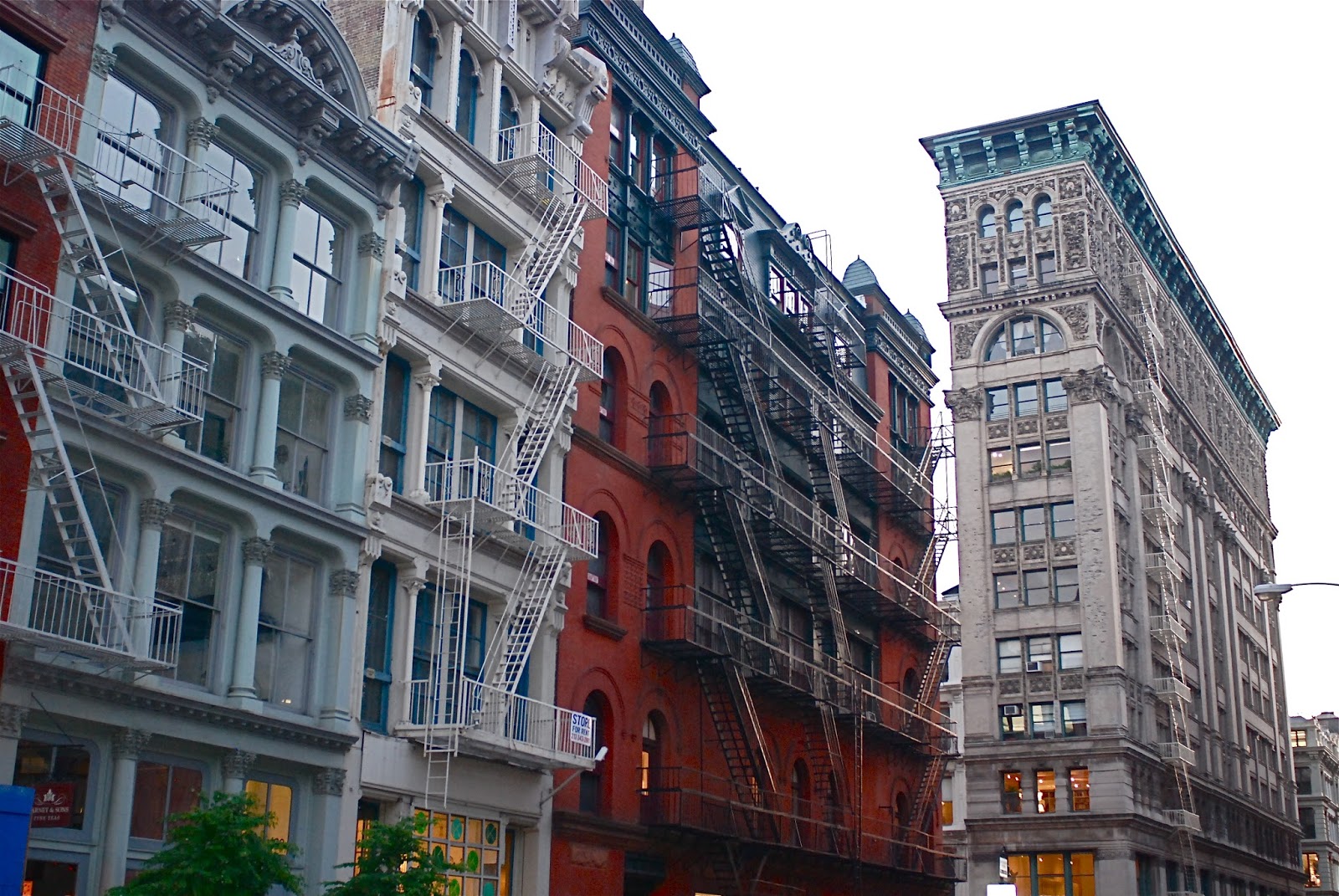
Broome Street in SoHo

SoHo is the former manufacturing district south of Houston Street (and bounded on the east by Lafayette Street, on the west by the Hudson River and to the south by Canal Street). The neighborhood is characterized by Belgian block streets and cast iron–facade buildings with enormously high ceilings—made to accommodate manufacturing equipment—and gargantuan windows, built to flood the floors with sunlight in the otherwise dimly lit gas-lamp days. Beginning in the 1960s and lasting through the 1990s, the district was the live/work playground of many of the city's most famous artists. Today those glorious 19th-century buildings, are occupied by retail stores and some are co-operative apartments, such as the beautiful building in the top photo (right) which is also known as Haggin Building, Silk Exchange Building, or the French Telegraph and Cable Building.